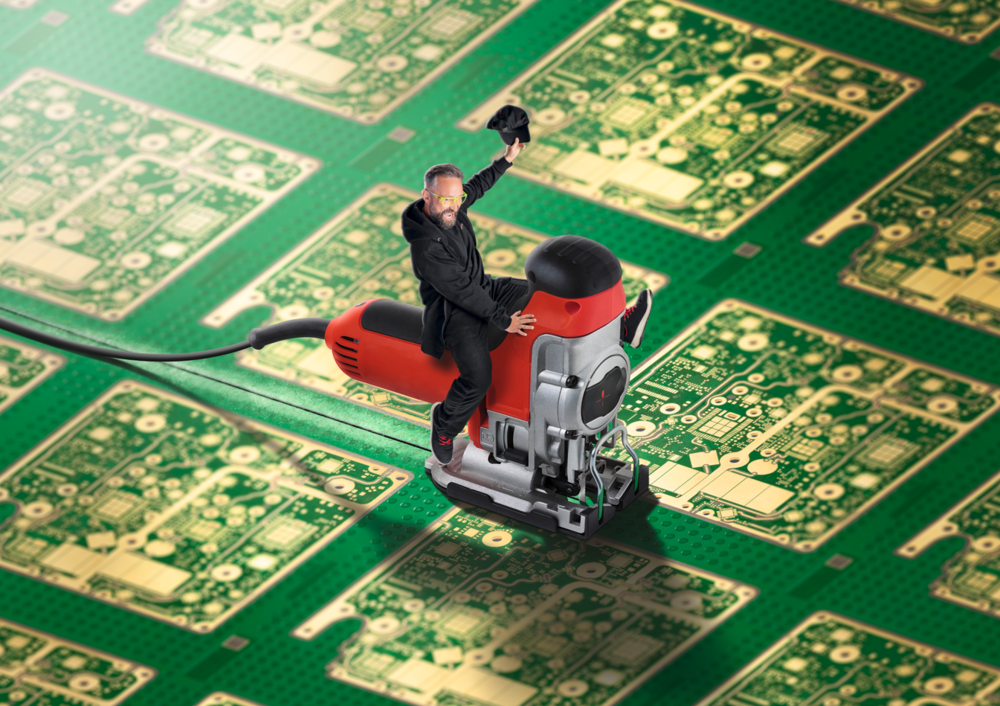
Every month, "People in Precision" shines a light on the technologies that define our work and the colleagues who bring them to life. In September, the focus falls on routing — the step that gives a circuit board its final shape, and often a good deal more than that.
Contour routing is where most people start. A rotating tool follows the programmed outline and separates the individual boards from the panel, leaving clean, burr-free edges within tight dimensional tolerance. It sounds simple, and it is anything but. Feed and speed have to match the material, chips have to be removed before they can damage the surface, tools have to be measured and monitored so a broken cutter never becomes a scrapped panel. Once the first cut is made, small parts want to move; good clamping (e.g. vacuum table or movable pressure foot for tabless/pinless routing) makes sure they do not.
Depth routing raises the demands considerably. Here the tool does not cut through the board, it stops at a defined depth — and the accuracy of that stop is measured in microns. In rigid-flex production, depth routing opens the rigid cover over the flexible section without touching the flex layer underneath. There is very little room for error: too shallow and the cover does not release, too deep and the flex circuit is damaged beyond repair. This is why depth is referenced against the actual board surface rather than the machine table, so local thickness variation and material tolerance do not translate into a scrapped panel.
The same capability opens the door to advanced stack-ups. Milled cavities create space for embedded components inside the board, and depth-routed pockets receive copper coins pressed in for thermal management, carrying heat away from power components far more effectively than plated structures alone. In both cases the depth, the flatness of the cavity floor and the position accuracy of the pocket decide whether the component or the coin fits as designed. Depth-controlled routing, precise Z-axis positioning, tool length measurement and stable clamping are what make these processes repeatable in series production rather than an experiment.
But the technology is only half the story. A routing system is the product of many hands working in precision. Our machine building team turns concepts into stable, high-accuracy hardware. Our software people translate contour and depth data into tool paths that land exactly on target. Our designers shape systems that are as precise as they are reliable. And our service team keeps every machine performing at its best, long after it leaves our doors.
That combination of technology and craftsmanship is exactly what "People in Precision" is about. In September, routing reminds us that the deepest cuts still call for the steadiest hands.
Contact us to know more — our sales team will be glad to advise you.