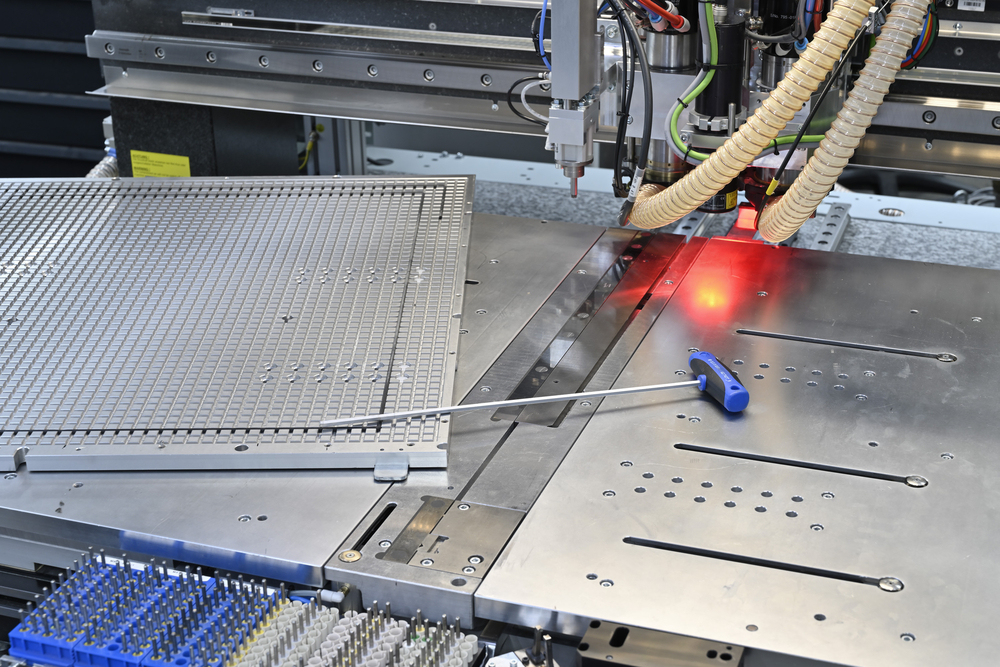
Positioning accuracy in mechanical processing begins with how the panel is held. Even a small amount of lift or movement translates directly into deviations at the hole or along the routed contour. Vacuum clamping addresses this at the source: it pulls the panel flat against the working surface and holds it there for the entire process.
Schmoll offers two variants:
- The vacuum table is a permanent solution, integrated into the machine as the standard working surface.
- The vacuum adaptor is mountable and dismountable, allowing operators to switch between vacuum clamping and conventional setups depending on the job. Both deliver the same clamping principle, with the choice depending on how consistently vacuum processing is required in a given production environment.
Flatness is the first effect. Panels that are not perfectly flat introduce variation across the working area and put uneven load on the tool. With vacuum applied across the surface, the panel is held in a defined plane over its full area.
This is also the precondition for some precise depth processing. Depth-controlled operations reference the panel surface. If that surface is not held in a stable, defined position, the achievable depth tolerance is limited regardless of how accurate the Z-axis itself is. Vacuum clamping removes that uncertainty and allows the machine's depth control to work to its full precision.
Stability is the third effect, and it becomes decisive in routing. Without vacuum, during routing of tiny elements, they could start to tremble. Vacuum clamping holds each part in position through the final millimetre of the cut, which protects edge quality and makes the depaneling of small formats considerably more predictable.
Vacuum clamping works together with the rest of the setup on Schmoll drilling and routing systems — multi-spindle configurations, automatic tool change, pressure-foot depth control and camera-based measurement — so that the accuracy achieved by the machine is not lost at the interface between panel and table.
Whether a permanent vacuum table or a flexible adaptor is the better fit depends on your product mix and your depth and routing requirements. Talk to our sales team about the right configuration for your application — we are happy to advise you.